Affordability • First-Time Buyers • August 25, 2026

5 Florida Homebuyer Myths That Are Costing You Real Money (And How to Move Past Them)

The biggest thing standing between most people and homeownership isn’t the market. It’s misinformation that’s been repeated so many times it started to sound like fact.

I work with first-time buyers and veterans across Pensacola, Cantonment, Pace, and throughout Escambia and Santa Rosa counties, and I hear the same hesitations over and over. People who are financially ready to buy sitting on the sidelines because someone told them something that simply isn’t true. So let’s clear the air on five myths that are holding buyers back right now, and talk about what the numbers actually look like.

You Don’t Need 20% Down. You Never Did!

This one might be the most stubborn myth in real estate. The idea that you have to come to the table with 20% down before you can buy a home has kept a lot of people renting far longer than they needed to. The reality is that there are multiple loan programs designed specifically to get qualified buyers into homes with far less.

VA loans, available to eligible veterans and active-duty service members, require zero down payment. FHA loans require as little as 3.5% down. Certain conventional loan programs allow as little as 3% for qualified buyers. If you’ve been waiting until you’ve saved up a massive lump sum, it’s worth having a real conversation about what you might actually qualify for right now.

Down Payment Assistance Isn’t Just for Low-Income Buyers

A lot of people assume down payment assistance programs are a last resort for buyers who can barely qualify. That’s not how most of these programs work. Florida’s Hometown Heroes program, for example, offers up to $35,000 in down payment and closing cost assistance to full-time workers in the community. Teachers, nurses, law enforcement, firefighters, and many other local workers qualify, regardless of whether they’d describe themselves as low-income. However this program does have a pay back requirement should you sell the home, refinance the mortgage, transfer the deed or stop using the home as your primary residence.

Nonetheless many mortgage lenders have their own proprietary down payment assistance (DPA) loan programs or even homebuying grants. These in-house programs are designed to attract buyers who have steady income but low liquid cash.

Some major lenders provide direct grants that range from $2000-$10,000. These grants do not require repayment and have no liens placed against the property. In addition lenders may offer specialized loan products such as low or no down payment conventional loans with 1% down programs where the lender chips in the other 2% or they may waive private mortgage insurance to lower your monthly obligation.

It’s best to shop around to fine the best program for your homebuying and financial goals.

Mortgage Insurance Isn’t Inevitable

Here’s something that doesn’t get said enough: not every loan comes with private mortgage insurance. PMI is tied to conventional loans when the down payment falls below 20%, but VA loans eliminate it entirely. For veterans and eligible service members, that’s a meaningful monthly savings that compounds over time.

When you picture two buyers with similar purchase prices and interest rates, the one using a VA loan with no PMI can come out hundreds of dollars ahead every single month. Over the life of a loan, that adds up to tens of thousands of dollars. If you’ve earned VA loan eligibility and you’re not using it, that’s worth a serious second look.

Sellers Can and Do Cover Closing Costs, Even Now

There’s a version of this myth that’s rooted in a real thing that happened during the ultra-competitive years when sellers had every advantage and buyers were waiving everything just to be taken seriously. The market has shifted. And even during competitive stretches, asking for seller concessions toward closing costs is a legitimate negotiation strategy, not a fantasy.

Closing costs in Florida typically run between 2% and 5% of the purchase price. That’s real money. A well-structured offer that accounts for seller-paid closing costs can make a meaningful difference in how much cash you need at the table. It comes down to how the offer is written and how it’s presented. That’s where having someone in your corner who understands the local market in Pensacola, Pace, and the surrounding areas makes a tangible difference.

Waiting for Rates to Drop Is a Strategy With Real Risk

This one feels logical on the surface. Rates are high, so wait until they come down. But here’s what that math often misses: home prices in this region aren’t standing still while you wait. Every month you delay is a month you’re not building equity. And if rates do drop significantly, the buyers who were waiting on the sidelines flood back into the market at the same time, which puts upward pressure on prices and creates the kind of competition nobody enjoys.

A solid foundation for this decision isn’t built on timing the market perfectly. It’s built on knowing your numbers, understanding your options, and buying when it makes sense for your life and your finances. Refinancing is always an option later. Buying at a lower price point while competition is calmer is an opportunity that doesn’t always come back.

The path to homeownership in Escambia and Santa Rosa counties is more accessible than most people realize. The myths are loud and wrong, but the facts right and can change the way you buy!

Have questions? Reach out to Daphanie “Dee” Goram at daphaniegoram@c21be3.com.

Realtor Thoughts • August 21, 2026

More Than Keys: The Moments That Remind Me Why I Love Real Estate

More Than Keys: The Moments That Remind Me Why I Love Real Estate

Each Week has its Moments!

There are weeks in real estate that are all about contracts, inspections, loan documents, deadlines, and emails. And then there are weeks that remind you why you chose this business in the first place.

This week was one of those weeks for me!

As a REALTOR® and Army veteran serving Northwest Florida, I have the privilege of helping people navigate one of the biggest decisions of their lives. But sometimes, the transaction becomes about something much bigger than buying a house.

It becomes about people, relationships, service, and new beginnings.

A Closing That Meant More

One of the most meaningful moments this week was helping a longtime friend purchase her home.

We have been friends since 2006. We are also both veterans, so being able to stand beside her during such an important milestone carried a special meaning for me.

After years of friendship, I suddenly found myself in a different role, helping her navigate the homebuying process and ultimately walk through the closing process.

And then came the moment every REALTOR® loves:

Keys in hand.

There is something special about watching someone you care about receive the keys to a place they can finally call home.

It reminded me that real estate isn’t simply about houses.

It’s about people’s stories.

Service Is Personal

This week’s special moment was helping a fellow veteran and longtime friend purchase a home. That experience brought my military background full circle for me. When I served in the Army, service meant showing up, doing the job, and taking care of the people around you.

Today, my uniform may be different, but that mindset has not changed. I still believe in showing up. I still believe in doing the job right. And I still believe that serving someone well means paying attention to the details that matter to them.

That’s something I try to bring into every transaction.

The Questions Behind the Questions

This week also reminded me how many questions homebuyers have that don’t always get asked. We talked about whether a REALTOR® can see a buyer’s financial information during the mortgage process.

I explored Community Development Districts and what they can mean for Florida homeowners with my buyer. We’ve discussed HOAs, property taxes, insurance, financing, and the many little details that can make buying a home feel overwhelming. Those conversations are exactly why I created my Homebuyer Question of the Week series.

Because sometimes the question that seems too small to ask, is the one that can make the biggest difference. My goal isn’t just to help people find a house. I want to help people understand the process.

An informed buyer is an empowered buyer.

Every Closing Has a Story

This week also reminded me that every closing represents a different chapter. For one person, it’s the first home. For another, it’s a fresh start. For a veteran, it may represent years of sacrifice finally turning into a place to call home. For a longtime friend, it can become one of those life moments you’ll remember years from now.

And for me?

It’s another reminder of why I love what I do. I get to meet people where they are, help them navigate the road ahead, and celebrate with them when they reach the other side. That is a pretty special job.

So, Who’s Next?

If you’ve been thinking about buying a home but haven’t taken that first step, you don’t have to have everything figured out before you reach out. You can start with a question.

  • Maybe you’re wondering whether you qualify.
  • Maybe you’re confused about VA benefits.
  • Maybe you’re trying to understand property taxes, HOAs, CDDs, insurance, or financing.
  • Or maybe you’re simply wondering, “Could I actually buy a home?”

Let’s have the conversation.

No pressure. No judgment. Just information and a plan.

Because behind every set of keys is a story waiting to be written.

Who’s ready to write theirs?

Dee Sells The City

Daphanie Goram | Army Veteran • REALTOR®
Century 21 BE3
Serving Northwest Florida

First-Time Buyers • August 17, 2026

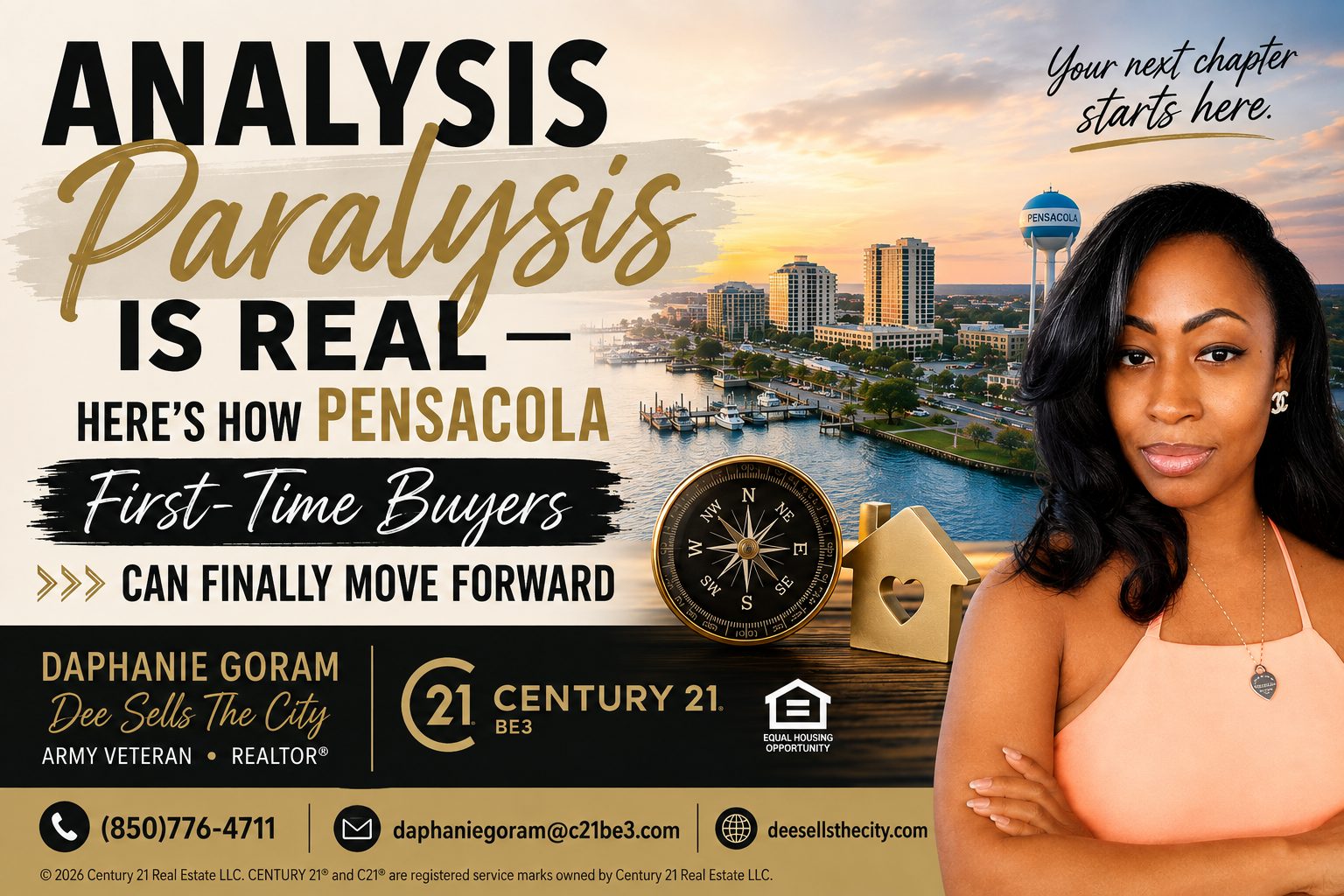
Analysis Paralysis Is Real — Here’s How Pensacola First-Time Buyers Can Finally Move Forward

The moment you decide you want to buy a home is exciting. The moment you actually try to start the process? That’s when a lot of people freeze.

It happens constantly with first-time buyers in Pensacola, Cantonment, Pace, and across Escambia and Santa Rosa counties. You start researching mortgage rates, then you fall down a rabbit hole about credit scores, then someone tells you about a neighborhood you’ve never considered, and suddenly you’re three hours deep into a Zillow spiral with more questions than you started with. That’s analysis paralysis, and it’s one of the most common reasons people stay renters longer than they want to.

Here’s what I want you to hear: the overwhelm is normal. But it doesn’t have to be permanent.

Too Much Information Is Not the Same as the Right Information

The internet gives you access to everything, which sounds like a gift until you realize that not all information applies to you. A national article about rising mortgage rates might be technically accurate and completely irrelevant to your specific situation in Escambia County. A YouTube video about buying in a high-cost metro has almost nothing to do with what the market looks like in Milton or Pace.

This is where a lot of first-time buyers lose their footing. They’re consuming information at full volume but none of it is calibrated to their actual income, their actual credit profile, or the actual neighborhoods they’re considering. The result feels like spinning your wheels. You’re doing the work, but you’re not getting closer.

The fix isn’t to stop researching. It’s to get local, specific information from someone who knows this market and knows your goals.

The Decision Isn’t “Buy or Wait” — It’s “What Do I Actually Need to Know First?”

One of the most paralyzing questions first-time buyers ask themselves is whether now is the right time to buy. That question sounds strategic, but it often becomes a way to avoid moving forward at all.

A better question is: what would I need to feel ready? For most buyers, the honest answer comes down to three things: understanding what they can afford, knowing what the buying process actually looks like step by step, and having someone in their corner who will tell them the truth instead of just telling them what they want to hear.

When you picture that kind of support, it changes the whole experience. You’re not white-knuckling your way through a complicated transaction. You’re making informed decisions with a clear path in front of you. That’s what the process should feel like, and it can, once you stop trying to figure everything out alone.

What Pensacola-Area Buyers Actually Have Going for Them

Here’s something that doesn’t get said enough: first-time buyers in this market have real options. Escambia and Santa Rosa counties have communities at different price points, and there are programs specifically designed to help first-time buyers and veterans get into a home without needing a large down payment or perfect credit.

VA loans, for example, are one of the most powerful tools available to veterans and active-duty military buyers, and this area has a significant military community. If you’ve served, you may already have access to financing that requires no down payment and no private mortgage insurance. That’s a solid foundation to build from, and a lot of buyers don’t even realize it’s available to them until they sit down with someone who knows how to use it.

New construction is also worth a serious look in communities like Pace and Cantonment. Builders in this area are actively working with buyers, and some offer incentives that can offset closing costs or help you lock in a rate. It’s not the right fit for everyone, but it belongs in the conversation.

Getting Unstuck Starts With One Honest Conversation

Analysis paralysis doesn’t break on its own. It breaks when you stop consuming and start doing, even if that first step is just a fifteen-minute phone call with someone who can look at your actual situation and tell you where you stand.

I work with first-time buyers and veterans across Pensacola, Cantonment, Pace, Milton, and throughout Escambia and Santa Rosa counties. I was raised here, I’ve served, and I understand what it means to want to put down roots in a place that actually feels like home. My job isn’t to rush you into a decision. It’s to give you the clarity to make the right one.

You don’t need to have everything figured out before you reach out. That’s kind of the whole point.

Have questions? Reach out to Daphanie “Dee” Goram at daphaniegoram@c21be3.com.
Affordability • August 13, 2026

You’re Not Waiting for the Right House. You’re Waiting to Feel Ready.

There is a moment many future homeowners know well. You scroll through listings, check mortgage rates, run the numbers, and then close the app. You want to buy, but questions about prices, rates, and timing keep you on the fence.

Sometimes, you simply want someone to tell you, “Now is the right time.”

Here is the truth: the perfect time to buy a home rarely announces itself. Instead, smart buyers focus on finding the right time for their situation.

The Housing Market Is Changing

Today’s housing market looks different from the frenzy many buyers remember. Existing-home sales fell 1.7% in July as higher mortgage rates continued to affect buyer demand. Read the latest Reuters housing report⁠

However, buyers are not completely powerless. Redfin reported that many markets now have more sellers than buyers, which can give buyers more time to compare homes and negotiate. See Redfin’s latest housing data⁠

That does not mean every seller will accept a low offer. It does mean buyers should not assume they must rush into the first home they find.

Waiting Can Cost You Too

Waiting sounds safe, and sometimes it is the right decision. You may need more time to save money, improve your credit, reduce debt, or build financial stability. Those are legitimate reasons to wait.

The problem starts when you wait only because you hope the market becomes perfect. Prices, rates, and inventory can all change while you sit on the sidelines.

Nobody knows exactly what the housing market will do next. Your personal financial situation may give you a much better answer than the latest headline.

What If Mortgage Rates Fall?

This question stops many buyers from moving forward. They think, “What if I buy now and rates drop next year?”

That concern makes sense, but buying a home today does not necessarily mean you will keep today’s mortgage rate forever. Depending on future market conditions and your loan, refinancing could become an option later.

You should never buy a home based solely on the hope of refinancing. Still, you should not automatically reject a home that fits your budget because today’s rate may not be the lowest rate you ever see.

Instead, ask yourself one simple question:

Can I comfortably afford this home today?

National Headlines Are Not Your Neighborhood

National housing reports provide useful information, but they cannot tell you exactly what is happening in your neighborhood. Pensacola, Pace, Milton, Cantonment, and other Northwest Florida communities can experience different inventory, pricing, and buyer demand.

Realtor.com provides current Pensacola market information that allows buyers to research local inventory and pricing. Explore Pensacola housing data⁠

One neighborhood may have several competing offers while another has homes sitting longer. One price range may move quickly while another gives buyers more negotiating room.

That is why local research matters before you decide whether buying makes sense.

Look Beyond the Mortgage Payment

Your mortgage payment represents only part of the cost of owning a home. Property taxes, homeowners insurance, HOA fees, maintenance, utilities, and other expenses can affect your monthly budget.

Florida buyers should also understand available property-tax benefits. The Florida Department of Revenue provides official information about the Homestead Exemption and other property-tax exemptions. Review Florida’s property-tax exemptions⁠

Understanding these costs before you shop can help you avoid falling in love with a home that does not fit your complete budget.

You May Be More Ready Than You Think

Many buyers believe they need everything figured out before contacting a Realtor. You don’t need to have a perfect credit profile, a perfect budget, or a perfect plan before you start asking questions.

You can begin by learning what homes fit your budget. You can explore neighborhoods, speak with a lender, and understand what you may need before making an offer.

Shopping for a home does not require you to buy one tomorrow.

Sometimes, the first step is simply getting clarity.

Stop Asking, “Is This the Perfect Time?”

Instead, ask yourself a few better questions:

Can I comfortably handle the monthly payment?

Do I expect to stay in the area for several years?

Is my income reasonably stable?

Do I understand my upfront and ongoing costs?

Have I spoken with the right professionals about my options?

If you can answer those questions with confidence, you may be closer to homeownership than you realize. You do not need perfect timing. You need a purchase that makes sense for your life, your budget, and your goals.

You Don’t Have to Beat the Market

Trying to perfectly time real estate can become exhausting. Prices change, rates change, inventory changes, and economic news changes almost daily.

Meanwhile, your life keeps moving.

Maybe your family needs more space. Maybe your commute has become unreasonable. Maybe you are tired of renting or ready to put down roots in Northwest Florida.

Those factors matter too.

The best home purchase is not necessarily the one that happens at the bottom of the market. It is the one you can afford, understand, and live with comfortably.

Your Next Step Does Not Have to Be an Offer

If you have been sitting on the fence, don’t feel pressured to jump. Start by learning your numbers, exploring neighborhoods, and understanding what your options look like.

Talk with a lender about your financing options. Tour a few homes so you can see what your budget actually buys. Then compare those numbers with your current housing situation.

You may discover that you are not ready yet.

That’s okay.

You may also discover something unexpected.

You may actually be ready.

The key is knowing the difference.

And that starts with a conversation, not a contract.

If buying a home has been sitting in the back of your mind, let’s talk about your options. No pressure. No guessing. Just a clear look at where you stand and what your next step could be.

Location Benefits • August 11, 2026

The Real Reason People Are Moving to Northwest Florida (And Why They’re Staying)

There’s a reason people drive through Pensacola once and start looking up home prices before they hit the state line on the way home. Northwest Florida has that effect on people.

The Gulf Coast Is Right There

Picture white sand beaches that look like something out of a travel magazine, except they’re just a short drive from your front door. The Gulf of Mexico coastline in this region is genuinely stunning, and it’s not a weekend destination for the people who live here. It’s Tuesday afternoon. It’s after work. It’s where you take your coffee on a Saturday morning. That kind of access to natural beauty changes the texture of daily life in a way that’s hard to put into words until you’ve felt it.

A Community That Actually Feels Like One

Pensacola, Pace, Milton, Cantonment — each of these communities has its own personality, but they all share something you don’t find everywhere: a sense of place. You can see it in the local restaurants, the weekend farmers markets, the way people wave at neighbors they actually know. Santa Rosa and Escambia counties have grown steadily over the years, which means you get real infrastructure and amenities without losing that grounded, small-town feel.

Outdoor Life Is Built Into the Culture

If you like being outside, this region will keep you busy. Hiking trails, fishing, kayaking through Blackwater River State Forest, and easy access to state parks make it easy to stay active year-round. The mild climate means the outdoors are genuinely usable most months, not just a few weeks in the fall. That rings true especially for people relocating from colder states who’ve spent years waiting for good weather to go outside.

Military and Veteran Roots Run Deep Here

Northwest Florida has a strong military presence, and that shapes the community in meaningful ways. There’s a culture of discipline, service, and respect here that a lot of people find reassuring when they’re putting down roots. For veterans especially, it often just feels right. Resources, community, and a shared understanding of what that life looks like make this area a natural landing spot for those who’ve served.

Moving to a new place is a big decision, and it deserves a clear-eyed guide who knows the area from the inside out. I grew up in this market and I’m proud to help people find their footing here, whether you’re buying your first home or starting a new chapter after service.

Have questions? Reach out to Daphanie “Dee” Goram at daphaniegoram@c21be3.com.

Affordability • August 9, 2026

The House You Can Afford Isn’t Always the House You Should Buy


Getting approved for a mortgage feels like crossing the finish line. It isn’t. It’s the starting gun.

Your lender tells you what you *can* borrow. Nobody hands you a document that says what you *should* borrow, or whether the house you’re falling in love with is actually going to serve your life well two, three, five years from now. That gap, between what’s possible and what’s wise, is where a lot of buyers get into trouble.

I work with first-time homebuyers and veterans across Escambia and Santa Rosa counties, and I’ve watched people make incredibly smart financial decisions, and a few costly ones. The difference almost always came down to whether they thought past the purchase price. Here are five things I want every buyer to sit with before they submit an offer.

1) Your Monthly Payment Is Not Just Principal and Interest

This is the one that catches people off guard most often, especially here in Northwest Florida. Your mortgage payment is one piece of a much bigger number. Add in property taxes, homeowner’s insurance, HOA fees if applicable, and flood insurance if the property sits in a designated flood zone, and that “affordable” monthly payment can look very different.

Coastal living is one of the great privileges of this region. But it comes with real costs. Wind mitigation matters here. Flood zone designation matters here. A home priced lower than comparable properties might carry a significantly higher insurance burden, and that burden doesn’t go away. Before you fall for a number, know the full number.

2) Location Has a Price Tag That Doesn’t Show Up on Zillow

A home in Pace or Cantonment might be priced more accessibly than something closer to downtown Pensacola or the water. That can absolutely make sense for the right buyer. But cheaper on paper doesn’t always mean cheaper in practice.

Think about your daily life. Where do you work? If you’re active duty or a veteran connected to NAS Pensacola or Corry Station, commute time is a real factor. If you have kids, school zones matter, and the schools across Escambia and Santa Rosa counties are not all the same. Gas, time, wear on your vehicle, the mental cost of a long commute every single day, those things add up. Picture yourself six months in, driving that route twice a day. Does it still feel like the right trade?

A good location isn’t just about proximity to the beach. It’s about proximity to the life you’re actually living.

3) What Are You Building Toward?

This question changes everything, and most buyers don’t ask it clearly enough. Are you buying a home you plan to grow into for the next decade? Are you buying something that gets you into the market now, with the intention of moving up in a few years? Are you thinking about it as a future rental property?

The honest answer shapes what you should prioritize. A starter home in a strong rental market can be a smart stepping stone. A home with more space and better schools might be worth stretching for if you’re planting long-term roots. Veterans using VA loan benefits have real purchasing power, and it’s worth thinking carefully about how to use it in a way that aligns with where you want to be, not just where you can get approved today.

There’s no wrong answer. But there is a difference between buying intentionally and buying reactively.

4) A Lower Price Can Be the Most Expensive Decision You Make

A home priced below market sometimes reflects an opportunity. Sometimes it reflects a problem. The two can look identical on a listing sheet.

Deferred maintenance, an aging roof, outdated electrical, HVAC systems that are running on borrowed time, these aren’t cosmetic issues. They’re budget line items waiting to happen. In a coastal climate like ours, where humidity, salt air, and storm season put real stress on a structure, condition matters more than it might in other parts of the country. A thorough inspection isn’t optional, it’s essential. And when the inspection comes back, read it like a financial document, not just a checklist.

A home that needs significant work isn’t automatically a bad buy. But you need to know what you’re walking into, and that cost needs to factor into your offer.

5) Think things through

Buying a home is one of the most meaningful things you’ll do, and it deserves more than a quick approval and a gut feeling. The right home isn’t just the one you can afford. It’s the one that fits your life, your plans, and your future, not just your loan limit.

Take the time to think it through. Ask the hard questions and work with someone who will ask them alongside you or go the extra mile to get the answers you need.

Have questions? Reach out to Daphanie “Dee” Goram at daphaniegoram@c21be3.com.

Military • August 7, 2026

Why Buying a Home at Your Next PCS Duty Station Is Smarter Than You Think

Renting feels like the safe move when you’re handed PCS orders. It’s flexible, it’s simple, and it doesn’t require much thought. But “safe” and “smart” aren’t always the same thing, and for military members moving to the Pensacola area, renting often means leaving serious money on the table.

**Your VA Loan Is One of the Most Powerful Financial Tools in Existence**

No down payment. No private mortgage insurance. Competitive interest rates. The VA home loan benefit is genuinely one of the best financial tools available to anyone in this country, not just service members. And yet, it goes unused by thousands of military families every PCS cycle because the process feels complicated or the timeline feels too short. Here’s the truth: with the right guidance, you can close on a home in the same window you’d spend apartment hunting.

**Escambia and Santa Rosa Counties Are Built for Military Life**

Pensacola, Cantonment, Pace, Milton — this whole corridor makes sense for military families. The commute to NAS Pensacola and surrounding installations is manageable from most of these areas, and the communities have grown up alongside the military presence here. You can get a feel for the difference quickly: neighborhoods that have strong schools, reasonable prices, and real long-term value. That combination is harder to find than people realize.

**Equity Builds While You’re Still on Orders**

A three-year tour isn’t a short time in real estate. Picture this: you buy at the start of your orders, you build equity for 36 months, and when the next set of orders comes through, you have real options. You can sell and walk away with profit. You can rent the home and generate income while you’re stationed elsewhere. That’s a fundamentally different financial position than handing over rent checks for three years and leaving with nothing.

**What Happens When You PCS Again**

This is the question that stops most people. The answer is simpler than it sounds. Renting your property when you leave is a legitimate strategy, and Pensacola’s rental market has strong demand, partly because of the steady rotation of military members who haven’t yet made the move to buy. Your asset keeps working for you even when you’re gone.

Buying during a PCS isn’t the risky move. Renting when you have a VA benefit sitting unused, in a market that rewards ownership, that’s the risk most people don’t talk about.

Have questions? Reach out to Daphanie “Dee” Goram at daphaniegoram@c21be3.com.